
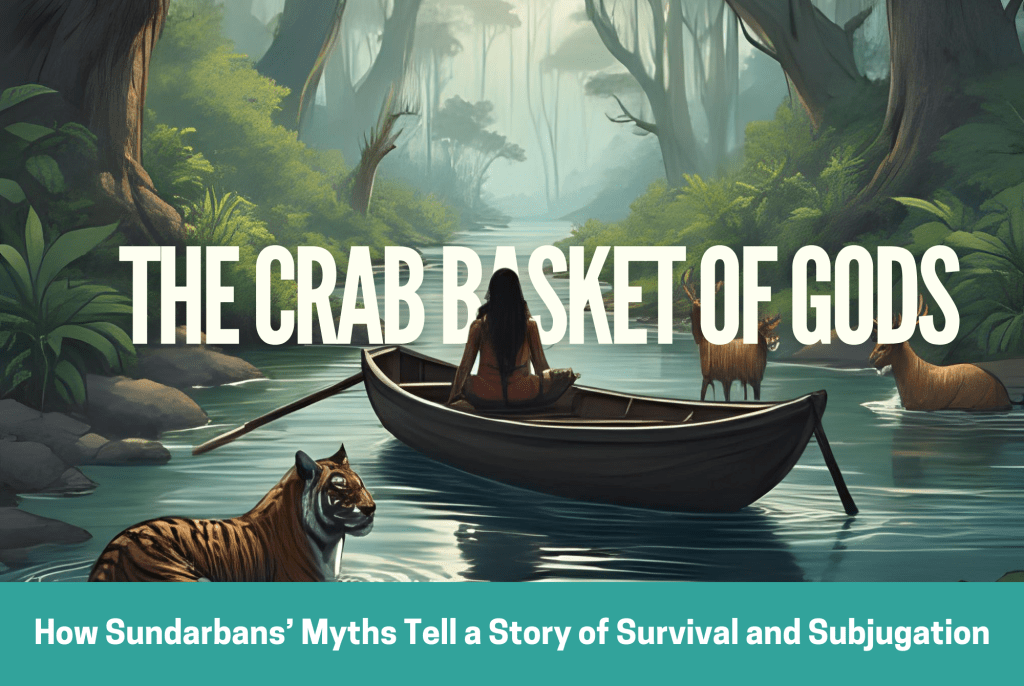
This month I travelled through the Sundarbans—Bhatir Desh, the land of ebb and tide—and on every island I stepped into, one name was whispered before anyone dared cross the mangrove’s shadow: Bonobibi. She is the Lady of the Forest, invoked by Hindus and Muslims alike, protector of the poor against the tiger-king Dakshin Rai. Her story, still retold in jatra folk plays and enshrined in clay idols, is not distant myth but lived faith, a ritual shield against the dangers of daily survival.

For the people of the Sundarbans, survival has always meant forays into the forest and rivers for honey, wax, fish, wood, or crabs. Each act of livelihood carries mortal risk—from snakes, crocodiles, storms, and above all, the tiger. Out of this constant danger grew a religious world that tied gods directly to the landscape, where protection was sought not from distant heavens but from deities who embodied these very threats.
And yet Bonobibi is not only a goddess. She is also a historical artifact, a record of how frontier societies have continuously reshaped their relationship with nature, power, and survival. Her story—and the myths that came before it—show us not timeless truths but a history of change, where gods rose and fell like the tides themselves. This history looks very much like a basket of crabs, each clawing upward by pulling another down. Older gods gave way to newer ones, animal deities became demons, and the poor who faced the forest most directly were disciplined by tales written, retold, and reshaped in the service of the powerful.
Bonobibi and the Johuranama
Bonobibi’s most enduring story comes from the Johuranama, a text recited even today in parts of the Sundarbans. Her name is believed to derive from older forest goddesses like Bonodurga and Bonochandi, and her story begins as she arrives from Mecca with her brother Shah Jangali, a Muslim saint. This narrative, a blending of Islamic and Hindu traditions, confronts Dakshin Rai, who, along with his mother Narayani, claims dominion over the forest.
At the centre of the tale is Dukhey, a poor boy betrayed by a greedy merchant and offered as sacrifice to Dakshin Rai. Bonobibi intervenes, saving him from Rai’s claws, and lays down her law for those who depend on the forest: “take only what you need.” This ethic has a double edge. On one hand, it protects those most vulnerable—the honey gatherers, the woodcutters, the crab collectors—reminding them to approach the forest humbly. On the other hand, it disciplines them, drawing boundaries around what they may take, while merchants and middlemen, who profit without entering the forest, remain outside the reach of her restraint. In this sense, Bonobibi embodies a fragile peace: offering protection, but also policing limits. And it is important to note how the forest itself is cast in this narrative—not as divine in its own right, but as hostile, embodied by Dakshin Rai and Narayani, whose role is to threaten human life.
Manasa and the Manasamangal
To understand Bonobibi, one must step back to the earlier tradition of the Manasamangal, where another goddess of the margins—Manasa—fought for recognition. Manasa is the goddess of snakes and floods, a deity who embodied the raw and uncontrollable forces of ecology itself. Her struggle is against Chand Sadagar, a wealthy merchant of the mainstream, who refuses to worship her. Supported by Shiva and Chandi, Chand represents the authority of established religion and privilege. Manasa kills his sons, one by one, until his daughter-in-law Behula pleads for mercy. Eventually, Chand submits, but grudgingly, never placing Manasa on the same level as Shiva.
This story is about more than a quarrel between gods. It marks the moment when animist, tribal deities were absorbed into Brahmanical order. What was once raw fear—snakebite, flood, disease—was domesticated into temple worship. This feels like one of the earliest “crab-pulls” of the Sundarbans’ mythic history: a powerful indigenous goddess dragged down by elites, only to be repackaged and allowed a place within respectable devotion. And her decline is visible even today. In some villages, she is still remembered annually, but compared to the constant invocation of Bonobibi, she feels neglected, a goddess tolerated rather than central.
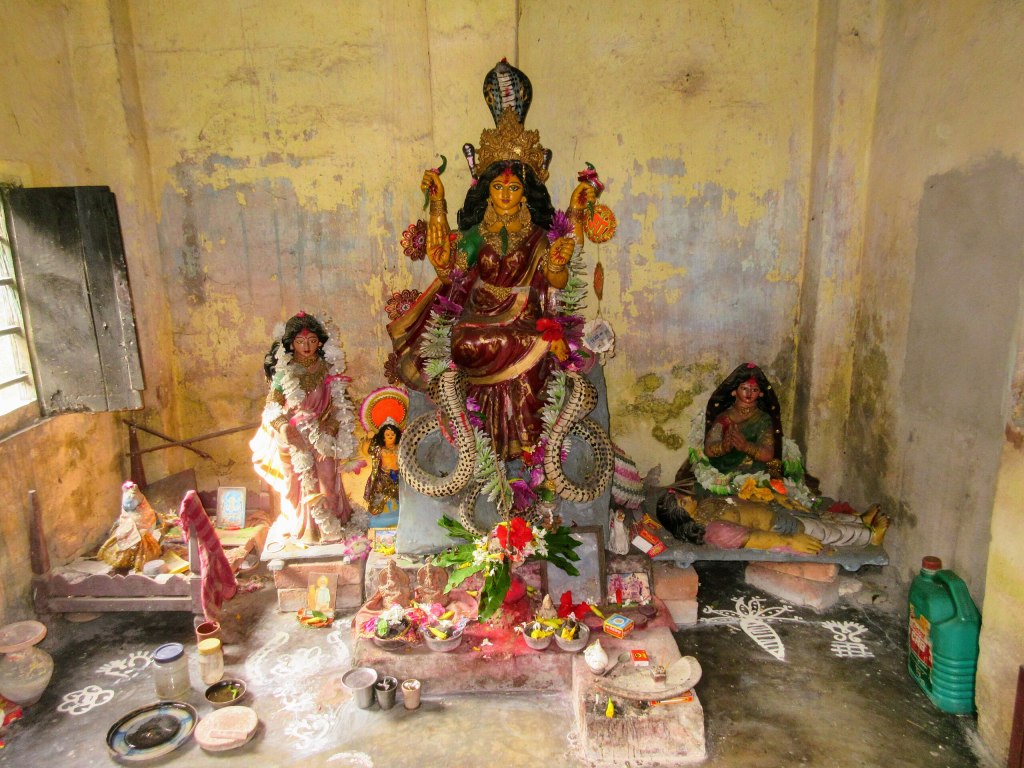
How Manasa Devi looks like in other parts of Bengal
Dakshin Rai and the Raimangal
By the seventeenth century, the axis of fear shifted from rivers to forests, and the tiger became the central threat. This coincided with ecological changes: when the Ganges altered its course, agricultural expansion cut off tiger populations from the mainland. Isolated in the mangroves, Sundarbans tigers adapted to saltwater and scarcity, and unlike most tigers worldwide, they began attacking humans. Villagers saw them not simply as predators, but as deliberate man-eaters.
It was in this context that the Raimangal (1686) introduced Dakshin Rai, ruler of the southern forests. Rai is a deeply conflicted figure. He is feared as the tiger-demon in the frontier “down” islands, an embodiment of the jungle’s cruelty. Yet, in the uplands, he is revered as a king, landlord, or hunter-chief protecting villagers from tigers. This inherent duality was likely not an evolution, but part of his very design. Rai was a failed god not because he lost power, but because he was created to be pliable, a figure whose identity could be molded to serve competing narratives. He was the feared man-eating tiger and also the powerful mainland religion followed by landlords or kings. His origin as the son of a sage, or his connection to Dakshineshwar, seems to be a later attempt to give this conflicted figure a respectable place within the Hindu pantheon. When Islam spread into Bengal, Rai faced a new challenger: Ghazi Sahab, the saint-warrior who tamed beasts and forests. Their conflict in the Raimangal encodes Mughal expansion into these frontier lands.

Entwined Patterns
What fascinates me is how these stories overlap, yet also diverge in telling ways. Bonobibi confronting Dakshin Rai and Narayani recalls Manasa struggling against Shiva, Chandi, and Chand Sadagar. In both traditions, we see a marginal goddess demanding recognition against established powers. In both, maternal figures—Chandi in the Manasamangal, Narayani in the Johuranama—stand behind the dominant order, while the new goddess—Manasa in one, Bonobibi in the other—seeks to displace them. But the outcome of these conflicts tells us something crucial about how the human–nature relationship was imagined at different moments. In the Manasamangal, it is Shiva and Chandi, aligned with Chand Sadagar’s mercantile authority, who ultimately overpower Manasa, forcing her into grudging recognition. Nature in this version is domesticated, subdued by human society and its gods. By contrast, in the Johuranama, it is Bonobibi—protector of human beings—who overcomes Dakshin Rai and Narayani. Here the marginal goddess does not bow to the older gods of the forest, but defeats them to secure the safety of her followers.
This rise of a powerful new goddess like Bonobibi is also linked to the mainland culture of Bengal. It is possible that the emphasis on powerful female figures in the myths was a local echo of Shaktism, the widespread worship of the Divine Feminine on the mainland. The inclusion of Narayani, a powerful maternal figure, in the Johuranama was a way to relate to this mainstream Hindu tradition, while Bonobibi was introduced to counter it and ultimately establish a new, unifying female-centric narrative. Interestingly, this also caused Ghazi Sahab to fall in rank; in the Raimangal, he is the clear hero, but in the Johuranama, his role is subordinated to Bonobibi’s, as a supporting figure who aids her in her battles.
The Fading of Other Gods
Not every god survived this reshuffling. Kalu Roy, the crocodile deity once invoked for river journeys, lost significance as the tiger became the primary narrative. Storm and river gods are little remembered. Even Manasa, once so powerful, now survives mostly as a ritual formality. In their place now, new gods from the mainland—Radha-Krishna, Kali, Durga—have grown stronger, reflecting migration, settlement, and the pull of wider Bengal. I am not denying that some gods have survived, but I argue that the larger story during each time period is shaped by who gets to tell it.
A broken idol of Ganga in Noakhali, Sunderban
Nature Without Its Own Gods
What stands out across these stories is how nature itself lost sovereignty.
- Manasa once embodied floods and snakes, but was reduced to a grudging place in the pantheon.
- Dakshin Rai was never stable, pliable to context, demonised in some places and deified in others.
- Bonobibi, though beloved, is less about the forest itself than about regulating human behaviour within it.
The gods who once were nature have been repurposed into moral lessons, guardians of human order. Because mangroves are obstacles to “development.” The forest, once divine, is now a backdrop—demonised, policed, managed.
Conclusion: The Crab-Basket of History
The myths of the Sundarbans are not eternal truths. They are living, layered histories, rewritten each time power shifted. They show how survival, greed, and nature have always been entangled—how each new order pushed down the old, like crabs in a basket scrambling for the top. Bonobibi protects, but also disciplines. Dakshin Rai terrifies, but also mirrors landlords and kings. Manasa demands recognition, but only after being domesticated. Kalu Roy fades, his rivers no longer central. Each story is a rung in a ladder climbed by pushing something else down. And what has been pushed down most is nature itself. Once sovereign, now voiceless. Once god, now villain. The Sundarbans will endure, its tides erasing and remaking islands. The question is whether humans can endure within it—without turning gods into instruments of control, and without silencing the very forest that gave those gods their power in the first place.
A Deeper Gaze
While these grand narratives show the mythic tide turning toward human control, the story on the ground might be far richer. The “people of the Sundarbans” are not a monolith; each family has its own relationship with these gods. A honey collector might offer special prayers to some unknown gods of the forest. A fisherman might sing to a powerful pir in a song that has been passed down for generations, even if the larger community has shifted its focus to the tiger. These smaller, persistent rituals—the tying of a red thread, the offering of a specific flower, a particular hymn sung at dawn—remind us that old beliefs don’t vanish. They persist, sometimes in secret, or evolve to suit the moment, demonstrating local agency and resilience. The myths may be used for social control by some, but for others, they are a source of profound comfort, healing, and community bonding, providing a moral compass and a sense of shared destiny in a difficult land.



 Rahagir
Leave a comment