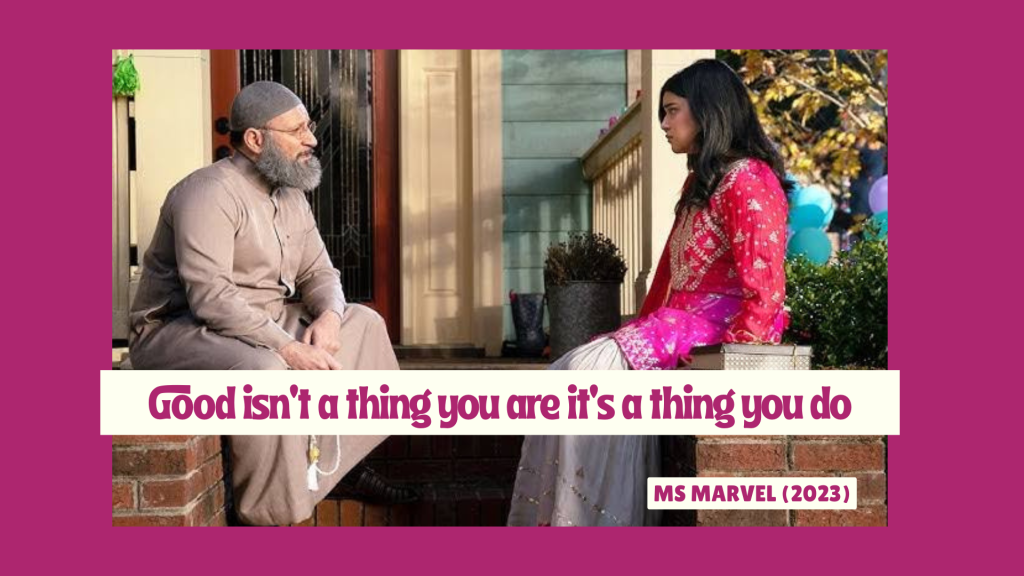
“I’m trying to be a good person. I’m trying to do good things. Why do I still mess things up?” “Because good isn’t a thing you are, Kamala. It’s a thing you do.” — Ms. Marvel (TV Series)
This line felt like comfort when I first heard it. Years later, it feels like instruction. We chase the idea of being good—like it’s a title, a badge, something permanent. But good isn’t a status. It’s a verb. A choice. A way of showing up, again and again.
We encounter this dilemma every day—in how we show up for loved ones, in how we respond to others’ needs, in what we say and do. Sometimes we reject the label of “good” out of rebellion or defensiveness, especially if we’ve been told we’re not enough. But goodness isn’t a crown you wear. It’s a compass you carry. Whether we want it or not, our values drive us.
That line isn’t just a reminder—it’s a relief. Because if goodness were a permanent state, we’d all be doomed the moment we slipped up. But it’s not. It’s a series of actions, a constant recalibration. And that’s the hope: You don’t have to be perfect. You just have to keep trying. But here’s the catch—the moment you start believing you’ve arrived as a “good person,” you stop growing. Worse, you start justifying the harm you cause because, hey, you’re one of the good ones.
When “Good” Becomes a Personality
I come from the development sector—where work is often about equity, justice, and social good. You’d think it would be immune to the ego traps of goodness, but in reality, it’s often the opposite. Doing good work becomes an identity. We conflate being associated with a cause as being synonymous with being good. Over time, that association becomes armor. Not out of vanity, but because it’s easier than interrogating your contradictions. I’ve seen this in people around me—and within myself. We get so consumed in the pursuit of being good that we stop to ask: is it even required to be seen that way? Or is doing good, consistently and consciously, the real point?
Praise feels nice—“You’re so kind,” “You’re a good human.” But when you start believing you are good, you stop questioning if your actions still are. Praise is earned in moments. It isn’t a lifetime license. And when we turn it into a trophy, we begin to justify behaviors that aren’t actually kind or ethical, simply because we once did something “good.” Goodness is not cumulative. It has to be renewed. It’s easy to use praise as proof of character—but praise should be feedback, not a shield.
The “Good Person” Shield: When Your Ego Hijacks Your Ethics
You’ve met them. Maybe you’ve been them. The people who preach inclusivity at work but roll their eyes when someone needs accommodations. Who call out offensive jokes but make exceptions for their own. Who demand empathy for their struggles but dismiss others’ pain as “dramatic.”
This isn’t goodness—it’s moral vanity. It’s using your “good deeds” as a get-out-of-jail-free card for the times you’re selfish, hypocritical, or just lazy. And the worst part? The more convinced you are of your own goodness, the harder it is to see the harm you’re doing.
When Goodness Becomes Branding
This extends beyond individuals. Consider companies that pat themselves on the back for offering menstruation leave but quietly pressure pregnant employees to meet unrealistic deadlines. Or managers who post about mental health awareness while mocking employees for taking sick days. “We’re like a family here!” they say—and just like toxic families, they demand loyalty while crossing boundaries.
This is what happens when goodness becomes a branding strategy instead of a practice. When you care more about looking good than being good.
The Patriarchal Progressive
Then there’s the classic example of the patriarchal progressive: the person who posts feminist slogans but expects his wife to handle all the childcare “because she’s better at it.” Who applauds gender equality in speeches but interrupts female colleagues in meetings. Who says “I support strong women”—as long as they don’t challenge him.
This isn’t empowerment. It’s ego in a woke disguise.
The Trap of “But My Intentions Are Good!”
Intentions, no matter how well-meaning, do not erase impact. You can “just be joking” and still humiliate someone. You can “just be honest” and still be cruel. You can “just be protective” and still be controlling. Goodness isn’t about how you see yourself. It’s about how you make others feel.
The Hope: Goodness Is a Practice, Not a Prize
Here’s the beautiful part: You don’t have to be a saint. You just have to stop keeping score. Your past good deeds don’t license future harm. You have to listen—especially when it’s uncomfortable. If someone says you hurt them, don’t defend yourself. Learn. You must question your own halo. The moment you think “I’m a good person,” you’ve stopped doing the work. And you must embrace the mess. You’ll screw up. Apologize. Do better. Repeat.
A Note to the Overthinkers (This Is Your Breather)
If you’re reading this and worrying, “Am I the problem?”—good. That means you care. But here’s your permission slip: You don’t have to be perfect. You don’t have to wear a crown. You just have to keep doing good, even when it’s hard. Because goodness isn’t about who you are. It’s about what you do—today, tomorrow, and every day after.

 Rahagir
Leave a comment