
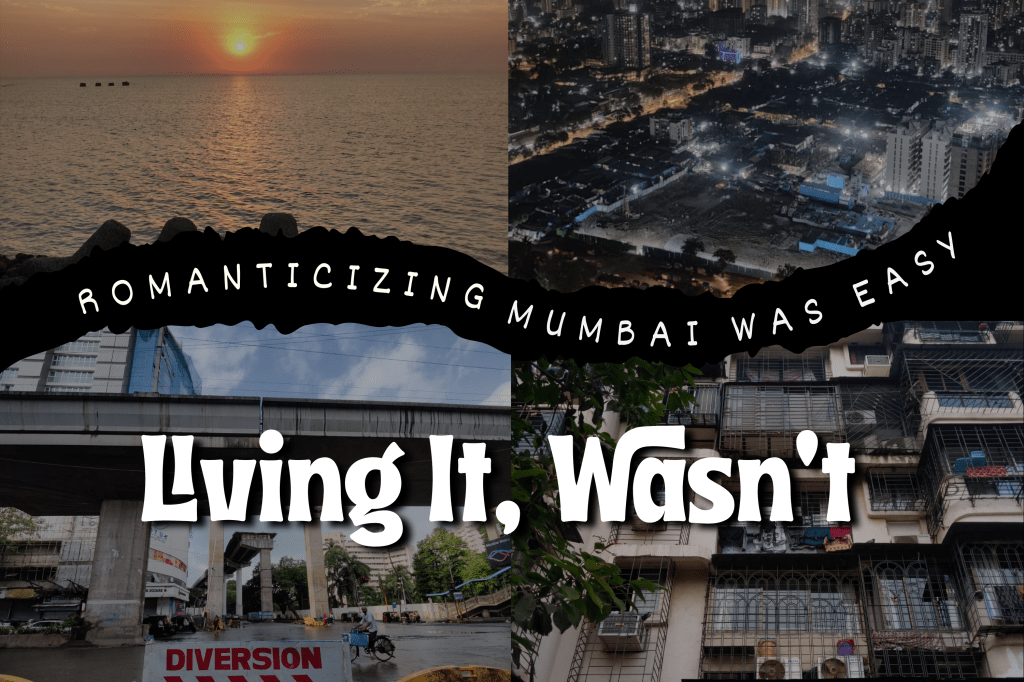
I officially moved to Mumbai three years ago, but my relationship with the city began much earlier. In 2014, I first arrived here – not as a resident, but as a traveler. I had this mental bucket list of things I wanted to tick off: places to visit, food to try, moments to romanticize. I stayed with my older brother back then and carried almost no responsibilities. I was just floating through the city, wide-eyed and curious.
Each trip after that only deepened my fascination. I would spend my days tracing its streets – sometimes barefoot on beaches, sometimes through forts, museums, and markets – trying to take everything in, frame by frame, like a movie I never wanted to end. Mumbai felt magical. Less chaotic, more welcoming. It was like stepping onto a giant film set, waiting for me to play a part.
Back then, I had lived Mumbai through Bollywood films like Wake Up Sid. For most of us, the city wasn’t just a place. It was an idea. A cinematic montage of ambition and struggle, of crashing waves and rising stars. Of Shahrukh’s bungalow, Marine Drive, and Antilla. It was sold to us like a promise: if you could make it here, you could make it anywhere. We romanticized it so deeply, we made love to the idea of Mumbai before knowing it fully.
Fate took me to the other side of the country for a while – Odisha, where I worked and lived. The stillness there unnerved me; I missed Mumbai’s constant hum. But in 2022, I returned to Mumbai with a job offer that brought me back to the very city I’d once dreamed of. This time, everything felt different. COVID had quietened Mumbai. The crowds were thinner, the local trains slower. And in that stillness, I could finally hear my own footsteps.
I found myself living in a one-RK in a quiet Versova building, with just 16 flats. And it was there that I met the people who would define my version of the city – colleagues, neighbours, coffee partners. Before I even reacquainted myself with Mumbai, I had stumbled into a connection. And that changed things. In a city that can be incredibly lonely, I didn’t enter alone.
I came with privilege – comfort, security, a good paycheck. I wasn’t fighting for space the way many do. But Mumbai has ways of humbling you. I eventually felt the weight of the struggle.
I saw the ups and downs of Mumbai – the gloomy peak-hour Borivali-to-Churchgate local train madness and the shiny, larger-than-life film studios and sets where I accompanied my friends trying to break into Bollywood. I saw it in the pubs full of people you’ve seen on TV, where we went through connections and invitations – and in the darkened cheap bars where peanut masala was a delight. One eye on the glitter, the other looking at the ground. That’s how Mumbai holds you – with contradictions.
I had landed in Versova – the heart of Bollywood’s ambition and failure. A place where careers were made, and just as quickly, lost. They say Mumbai never sleeps. I saw that. We’d head out late at night, and the city would still be sparkling. But that sparkle wasn’t always by choice. Some people stayed awake because they didn’t have the privilege to rest. Behind the glamour was a relentless pulse – because here, sleep is a luxury, glamour is a privilege, and survival is a daily hustle.
Dreams don’t float here. They coexist with one-RKs, leaky ceilings during the monsoons, and never-ending hustle. They gather outside tech parks with glass buildings and film studios with mammoth gates. But the reality lies at 6 PM in Dadar Station, in the queue for autos, and in the signal that makes you count to 150. It is gritty, exhausting, and painfully real. And yet you keep chasing your dreams without taking a pause to ask yourself – do you really want this? And even when you think you’ve caught one, the city shows you bigger ones – through glass windows you can see but never touch.
The funny thing is that in the crammed, tight, and colourless buildings of Mumbai, my attention only goes to the glass windows. Oversized, everywhere – like silent frames to a thousand stories. From your window, these windows open to a multiverse of Mumbai lives – one held a family of six stretching a single room into a home. Another, a bachelor living in an aesthetic, charming flat. A penthouse glowing against the sky, while below, a slum flickered with life. Both lit by the same moon.
These windows aren’t just glass. They are mirrors. They make you reflect on what you have, what you wanted, and what you were willing to give up. They reminded me that Mumbai can be terribly lonely – and yet, in that loneliness, everyone is looking for something or someone to hold onto.
And ironically, while native Mumbaikars complain that the city has changed because of migrants – a representation that can include me – it’s worth remembering that Mumbai has always been in flux. The Parsis, the Anglo-Indians, the Gujaratis – they were migrants too. And migrants have made this city what it is. While people who came in the early 2000s may have built the infrastructure, the city is much more than that. It is not just between Dadar and Colaba – but the whole of Mumbai that has made it. From Virar to Andheri and Thane to Navi Mumbai. From autos to industries and tech parks to khau gallis.
The sad part is that the only constant in this city is the cycle of dreams, disappointment, resilience, and legacy passed down through struggle.
Romanticizing Mumbai isn’t about the skyline or the film sets. It’s about what you see through those windows. What you’re willing to lose – or find – in the process. Because this city doesn’t hand you dreams. It hands you a mirror. It doesn’t stop for you. But it shapes you.
And if you’re lucky – really lucky – you find your people. The ones who help you make peace with your own madness. The ones who sit with you late into the night, talking about the lives you want to live. The ones who choose to be with you in the mess, not just in the movie.
I came looking for a city.
And somewhere in its streets, studios, balconies, traffic jams, coffee shops, late nights, and colourless buildings – I asked difficult questions and found myself.


 Rahagir
Leave a comment