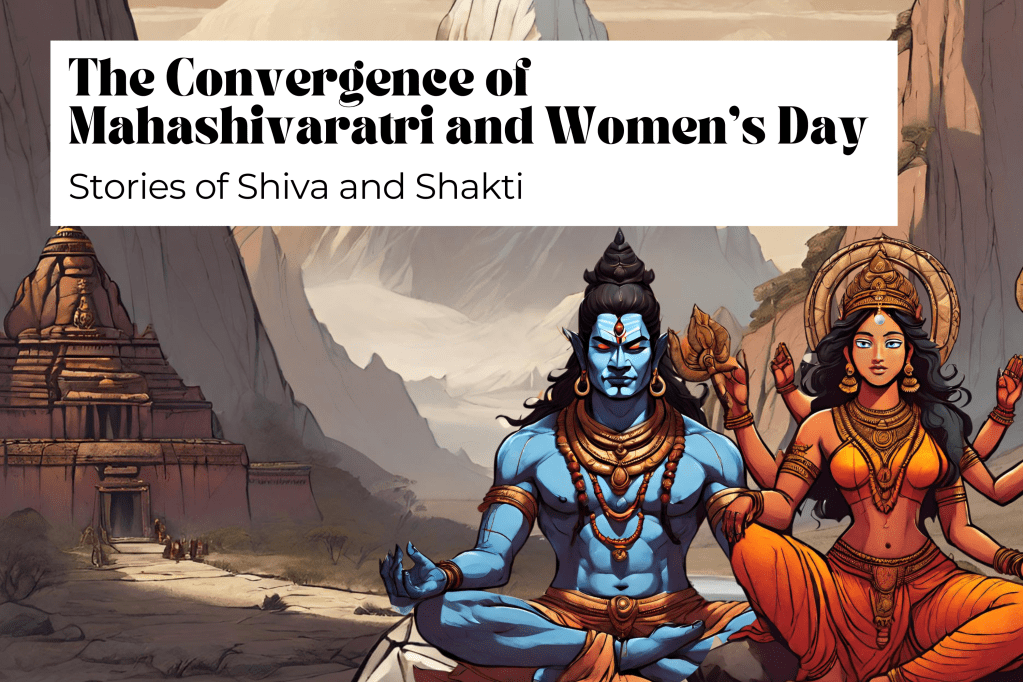
“There is no point in defining what Shiva is because a) The concept of Shiva is indescribable; it is what is beyond our understanding, one that originates from nothing and goes into nothing. b) We all have a version of him in our mind, and with Hinduism scriptures, I feel it is ok to have that. But for those who don’t know who Shiva is, for them, Shiva is one of the trinity gods that are the primary gods in Hinduism. In popular culture, Shiva and Shankar are merged to call what is Mahadeva (The Great God), god of destruction, consort of Shakti, an Adiyogi (the first yogi), and father of gods Ganesha and Kartikeya. In Shaivism, a sect of Hinduism, he is the supreme god. (I will use Shiva/mahadeva quite synonymously during the entire article)
Mahashivratri has a number of significance and is celebrated as a huge festival in India. The day came about because of two events – the day Mahadeva drank poison and the day Mahadeva and Mata Parvati got married. The first event is what sets Mahadeva as a benevolent god. In this story, the ocean is churned by the gods and demons (a story that appears in a lot of mythologies across the world). One of the things that come out of the churning is a vicious poison that can destroy the world, and it is he Shiva who drinks it and rests the poison in his neck itself giving him the name Neelkanth (Blue Neck, blue because of the poison) and saves the world. The second event is when Mahadeva and Mata Parvati get married.
While writing about Mahashivratri and noticing that it falls on the same day as International Women’s Day, I thought about highlighting stories of Mahadeva, in which he is quite an ally to the women and showcases emotions quite contrary to how he is depicted in his most masculine form (and how emotions don’t make him weak, unlike what a majority of his male worshippers feel). The stories of Mahadeva are immense in mythology, such is his significance in it, but one of the first things to point out is how a lot of his stories intersect with Shakti, his consort. Even a day celebrated for him has a huge connotation to Shakti being a significant part of his story.
Shakti as consort, energy that drives this world
In a Mahabhagavata Purana tale, Shakti, the Great Goddess, forms Brahma, Vishnu, and Shiva. To win her as a wife, they face a test where she takes on a terrifying form as Kali. While Brahma and Vishnu turn away in fear, only Shiva remains steadfast and earns the right to marry her.
In stories of Shiva and Shakti, the themes are consistent. The women choose Shiva as their consort and not otherwise, sometimes in surprise to their parents or the world around them because of Shiva’s nature as an ascetic in these stories. However, the themes are quite interesting, with Shakti as a concept. Shakti completes Shiva. She is what makes him, and he is how she exists. It is the perfect yin-yang situation. Shakti symbolizes the energy of what makes Shiva Mahadeva, and he makes her the shakti to save the world.
To the extent that scriptures say – “Without Shiva, there is no Shakti, and without Shakti, there is no Shiva. He who sees Uma and Shankar as one and the same, sees in reality (i.e., knows the truth)”
The heartbreak of Shiva with Sati
With Sati, the stories make Shiva and Shakti more human. Sati, the first avatar of Shiva is a doomed character. Sati in her life doesn’t realize she is Shakti, the way she does when she is reborn as Parvati. In life as Sati, she loves Shiva, goes against her patriarchal father to break laws of her country and marries someone considered an outsider to civilized society. Her demise is heartbreaking as she sacrifices herself not able to bear the insults thrown at her.
What happens afterward is war, Shiva loses himself, burns the world in grief. It’s a tale of love and heartbreak, ending with Shiva punishing everybody who was involved in the death of Sati. The gods come together to show respect to her, recognizing her as a god amongst them and promising not to let it happen again. (The practice of Sati Pratha has weirdly been misinterpreted from this story and from some other rituals mentioned in Vedas)
Falling in love and being a devoted husband
In her second birth, Shakti comes as Parvati, the more prevalently known name. From the moment she is born, unlike Sati, Parvati knows she is divinity. She is Shakti, and she understands her role in the world. For her to be equal to Shiva, she performs severe tapas and yogas in the Himalayas and lives the same lives as Shiva in the extremities.
Shiva and Parvati’s Marriage
Shiva and Parvati’s marriage is one of the most interesting folklore. Unlike Sati, Parvati convinces her parents to get her married to Shiva, and they do accept. On the day of marriage, Shiva and his gans who are very happy bring a baraat to the door of Parvati’s palace, but to everybody’s horrors, Shiva’s Baraat is of ghosts and people clad in ashes. Shiva himself is dressed in attire of animal skin and ash over his body. Parvati’s parents object to Parvati being married to someone looking like that, and on Parvati’s requests, Shiva actually dons the avatar of a predominantly known look of god with jewels crown and expensive cloth. In this story, he is not only benevolent but someone who listens to his wife but also respects the culture of her family even when he is a god and he doesn’t need to. This marriage is celebrated across India as Mahashivaratri.
Neelkanth and role of Shakti
As discussed above, the other story of Mahashivratri, when Shiva drinks halahal poison to save the world, it is actually Shakti who comes and keeps a hand over his neck to not let the poison trickle down his body. He has the strength to manage and destroy the entire universe, and yet his stories are not his heroics alone but also have Shakti with him helping him. In many stories of Hinduism, Shiva and Parvati take several forms to aid them in their battles. Both are equally powerful, and don’t need each other, and yet they are with each other because that’s how the natural world order is.
Being an ally to Mata Parvati In a few stories
Mata Parvati doesn’t realize the full extent of her powers in the beginning. Shiva in these stories becomes a catalyst for her to become Durga (a warrior form of the goddess). Shiva in these stories need not be the protector of womankind and fight her wars. In those stories, Shiva stands behind her and supports her to become a warrior and fight some battles alone.
One popular image of Kali
A popular image of Kali (a fierce form of the Goddess) has her feet over Shiva’s chest. This is in reference to a story where Shakti has to take such a fierce form that she becomes uncontrollable. A counterpart to Shiva’s Veerbhadra/Rudra avatar, where he becomes so destructive that no one is able to control him. Similarly, such is Kali’s fierceness that it has to take Shiva to lie on her path and absorb her anger for her to control. In a patriarchal Hindu society, Shiva’s step might have been out of place, but he does that unabashedly. He is there for her, even if it means being stepped on by Shakti.
ArdhNarishwar
Ardhnarishwar comes from three words – ardh meaning half, nari meaning women, and ishwar meaning god. It is the realization that the supreme god is half female. In many stories containing ardhnarishwar, whenever Parvati’s place beside Shiva was questioned, the lord shows his true form where he himself is half female and the true form of god is half male and half female. Ardhnarishwar is not a new concept or a concept brought in later to Hinduism; it is one of the core ones. And among all gods, it is Shiva who encapsulates the ideology because it is him who can. The masculinity in Shiva is so supreme that it does not get hampered by Parvati’s presence or bowing down to her or recognizing even half of him is her. It is this value that is a lesson for Shiva’s followers who should know there is no worship of Shiva without Shakti because they both are equal and one.
Origin of stories of Shakti
The Shakti sect of Hinduism Shaktism, like Shaivism and Vaishnavism, is one faction of Hinduism that believes Shakti to be the source of everything. Like the rest two sects of Hinduism, it is not new; it is as ancient as Vedas are. All three sects understand the ancient scriptures that are the Veda; the difference is in sometimes the interpretation and in the context.
In conclusion, while acknowledging that certain mythological stories may portray regressive views towards women, it’s crucial to recognize that not all narratives follow this pattern. This perspective is particularly enlightening for those who haven’t critically examined our cultural tales and grasped their complete context. Shiva, through these stories, serves as a positive example of how one can be an ally to the women in their life. There’s value in extracting lessons from these narratives, fostering a deeper understanding and appreciation for cultural nuances.



 Rahagir
Leave a comment